
Context
As part of my preparation for the SheBuilds hackathon by Lovable, I created a short survey and shared it across different channels to collect feedback from people who have relocated to a new city or country.
The goal was to better understand the real challenges people face when trying to find trusted help for everyday needs, and to make sure I wasn’t defining the problem only through my own experience and assumptions, especially since I’m also part of the target audience.
In parallel, I reviewed existing research and publications around trust, caregiving, and letting strangers into private spaces like homes.
This combination of user feedback and reliable research helped me define the MVP for the hackathon.
My initial assumptions
Before collecting any structured feedback, I had a few working assumptions based on personal experience and informal conversations:
- The core problem is not a lack of people willing to help, but a lack of trust
- Existing platforms don’t fully address this trust gap
- Personal recommendations play a central role
- Trust is highly context-dependent (people trust recommendations from people “like them”)
One of my main goals with the survey was to validate which of these assumptions held true, and where I needed to refine my thinking.
What I learned from user feedback
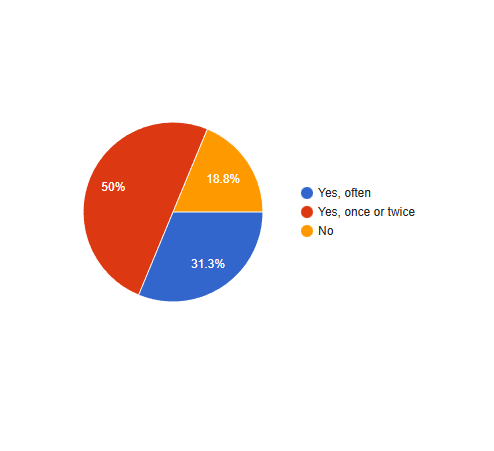
I received 16 survey responses. While this is a small sample, the patterns were consistent and aligned strongly across answers.
1. Trust is the main blocker, not availability
Most respondents already have access to options. The challenge is deciding who they can actually trust.
2. Recommendations matter more than price or convenience
When asked what matters most, trust and recommendations consistently ranked higher than availability, flexibility, or cost.
3. Trust is built gradually
Many people described similar steps before making a decision:
- initial messages
- a call or video call
- meeting in a public place
- only then allowing someone into their home
This suggests trust is not a single moment, but a process.
4. Context makes recommendations meaningful
Knowing who recommends someone — and why that recommendation is relevant — makes a significant difference. Shared context (family situation, location, language, background) increases confidence.
What reliable research says about trust
To complement the survey, I looked into existing research on trust in caregiving and home-related services. Several themes closely matched the user feedback.
Lack of Clear Trust Indicators
People find it hard to judge strangers when they don’t have enough context or reliable information about them. They need clear signs they can understand and feel confident relying on.
High emotional and personal risk
Leaving children, pets, or access to one’s home with someone unknown creates a strong sense of vulnerability. The perceived cost of making a wrong decision is very high.
Importance of references and existing networks
Research consistently shows that personal recommendations reduce perceived risk. Without them, people hesitate or avoid acting.
Privacy and home access
Letting a stranger into a private space introduces psychological barriers that don’t exist in other types of services.
Uncertainty around competence and accountability
Without clear proof of experience, responsibility, or recourse if something goes wrong, people feel exposed.
I was positively surprised to see how closely this research aligns with what respondents shared in the survey.
These are some of the sources I’ve used to collect these ideas:
- Trusted strangers: Carework platforms’ cultural entrepreneurship in the on-demand economy
- Why Do We Trust, or Not Trust, Strangers? The Answer is Pavlovian, New Psychology Research Finds
- Strong family ties hinder the development of trust in strangers | Department of Sociology
- https://elpais.com/clima-y-medio-ambiente/2025-07-30/asi-funcionan-las-apps-que-encuentran-vecinos-para-cuidar-tu-perro-o-tu-gato-en-vacaciones.html (in Spanish)
- The Importance of Trust in Successful Home Visit Programs for Older People – PMC
Assumptions validated (and refined)
Validated
- Trust is the core problem, not supply
- Recommendations play a key role
- Context strongly influences trust
Refined
- Trust is not binary; it develops over time
- Generic reviews are not enough without context
- People actively create their own trust-building steps
This helped me move from abstract assumptions to more precise product principles.
Key takeaway: trust is not a feature
One of the strongest learnings from this phase is that trust cannot be treated as a feature that can simply be added to a product.
Trust emerges when uncertainty is reduced through context, transparency, and gradual exposure. Products shouldn’t rush users into decisions, but support them while they build confidence.
How this impacts the MVP
Based on both user feedback and research, these principles are guiding the MVP for the hackathon:
What I will focus on
- Making recommendations visible and understandable
- Showing who trusts whom, and why
- Highlighting shared context
- Supporting gradual trust-building rather than instant matching
What I am intentionally leaving out
- Payments or transactions
- Generic star ratings or reviews
- Complex verification systems
- Trying to cover every possible service
Keeping the scope narrow is intentional. The MVP is meant to test whether these trust validation resonate, not to solve everything at once.
Defining the MVP
Based on the survey feedback and existing research, the MVP for this hackathon is intentionally focused.
The goal is not to match people with services or handle transactions, but to reduce uncertainty by making trust visible and understandable.
The MVP focuses on a simple flow:
- users describe their context (location, type of help, situation)
- they see people who have been recommended by others
- each recommendation shows who trusts whom and why
- context is visible, not hidden
- the product supports a gradual first step, not an instant decision
This approach reflects how people already build trust in real life: through context, shared experiences, and small, careful steps.
To keep the scope focused, several elements are intentionally left out of the MVP, including payments, star ratings, anonymous reviews, and complex verification. The goal is clarity, not completeness.
Defining the MVP and main user flow
With the key learnings from user feedback and research in mind, I defined a very focused MVP for the hackathon.
The core user flow
The MVP follows a simple sequence:
“I’m new here → I see people others trust → I understand why → I take a safe first step.”
Each screen in the product supports one part of this journey.
Screen 1: Context
The first screen helps users describe their situation in a lightweight way:
- city or area
- type of help they’re looking for
- relevant context (for example, parent, expat, language)
This step is not meant to be full onboarding. Its purpose is to frame the experience so that recommendations feel relevant and personal from the start.
Screen 2: People others trust
The second screen shows a short list of people who have been trusted by others.
At this stage, the main unit is the person, not the recommendation itself.
Each person is shown with:
- the type of help they provide
- how many people trust them
- a small amount of context (for example, “recommended by parents in your area”)
There are no ratings, rankings, or prices. The focus is on reliability, not comparison.
Screen 3: Why people trust this person
On the detail screen, users can understand why a specific person is trusted.
This includes:
- who recommended them
- in which context
- a short note about the experience
By keeping recommendations tied to real people and situations, the product avoids anonymous or generic feedback.
This screen is the core of the MVP, as it translates abstract trust into concrete information.
Screen 4: A safe next step
Instead of pushing users to make a quick decision, the final step offers a gentle call to action: request an introduction.
This replicates what many people already do in real life:
- starting with a call or video call
- meeting in a public place first
The goal is to reduce pressure and make the first step feel safe.
What the MVP intentionally leaves out
To keep the scope focused, several elements are intentionally not part of the MVP:
- payments or transactions
- star ratings or generic reviews
- complex verification systems
- chat or messaging features
These elements may be valuable later, but they do not directly address the core trust problem the MVP is designed to explore.






 Marina Hernández
Leave a comment