
If you interact with AI in a language other than English, this might interest you.
When I started working with AI models, I prompted primarily in English, sometimes in Spanish, and occasionally in German, mainly when dealing with local topics.
But I noticed that the responses I got in Spanish and German were not always as good as the ones in English.
I assumed that the AI would “translate” my input into English, access its full knowledge base, and then translate the answer back.
But I was wrong.
What really happens is that the AI models rely first on data in the same language you use.
So if you ask something in Spanish, it responds using Spanish training data.
Same with German, French, Chinese… Unless the data is missing, it doesn’t “switch to English” under the hood.
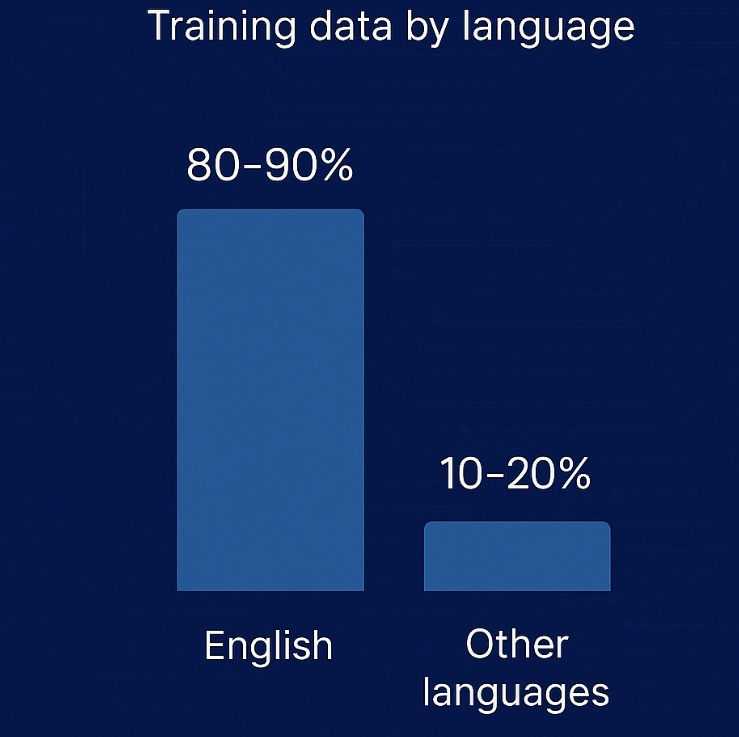
The problem is that large language models are trained on datasets where:
- English represents 80–90% of the data
- Spanish, German, French, Chinese, Arabic, etc. only represent 1–4% each.
The size and quality of the training data directly affects how “smart” the AI performs in each language.
Which means that prompting in non-English languages accesses a much smaller, potentially lower-quality data pool. You get fewer examples, worse concept connections and more generic or even awkward answers. Also, language nuances are not always well understood.
After learning about this, I mostly prompt in English, unless I specifically need cultural or legal context.
This finding also made me reflect on how the lower quality of AI results in other languages can affect the socio-economic development of certain countries, while giving others an advantage, especially as these tools are increasingly used to automate processes.
Something to think about 🤔





 Marina Hernández
Leave a comment